With fewer migrants to worry about, I had more time to look at some of the resident species and I was able to photograph a few that have not posed for me before. This is partly because I don't like to carry a camera with me through the more occupied areas, so I usually only get it out when I reach the northern end of the island where there are fewer people and where they are a bit more familiar with me by now.
Saturday, 5 February 2011
My first winter trip to Tuti Island
With fewer migrants to worry about, I had more time to look at some of the resident species and I was able to photograph a few that have not posed for me before. This is partly because I don't like to carry a camera with me through the more occupied areas, so I usually only get it out when I reach the northern end of the island where there are fewer people and where they are a bit more familiar with me by now.
North of Juba
Landscape 15kms north of Juba - nests are of White-browed Sparrow-Weavers Plocepasser mahali
White-browed Sparrow-Weavers
Among the first birds seen are Grey-backed Fiscals Lanius excubitoroides and Rueppell's Long-tailed Starlings Lamprotornis purpuropterus.
Rueppell's Long-tailed Starling with Grey-backed Fiscals
There are a few flooded borrow pits, which attract hordes of small birds such as weavers ploceus sp., Black-rumped Waxbills Estrilda troglodytes and Red-billed Firefinches Lagonosticta senegala.

Black-rumped Waxbills
The weavers are not in breeding plumage, but seem to include Northern and Lesser Masked P. taeniopterus and P. intermedius, as well as Black-headed and/or Vitelline Masked P. cucullatus and P. velatus.
A confusion of weavers
There are lots of doves, including Namaqua Doves Oena capensis, as well as Vinaceous Doves Streptopelia vinacea.
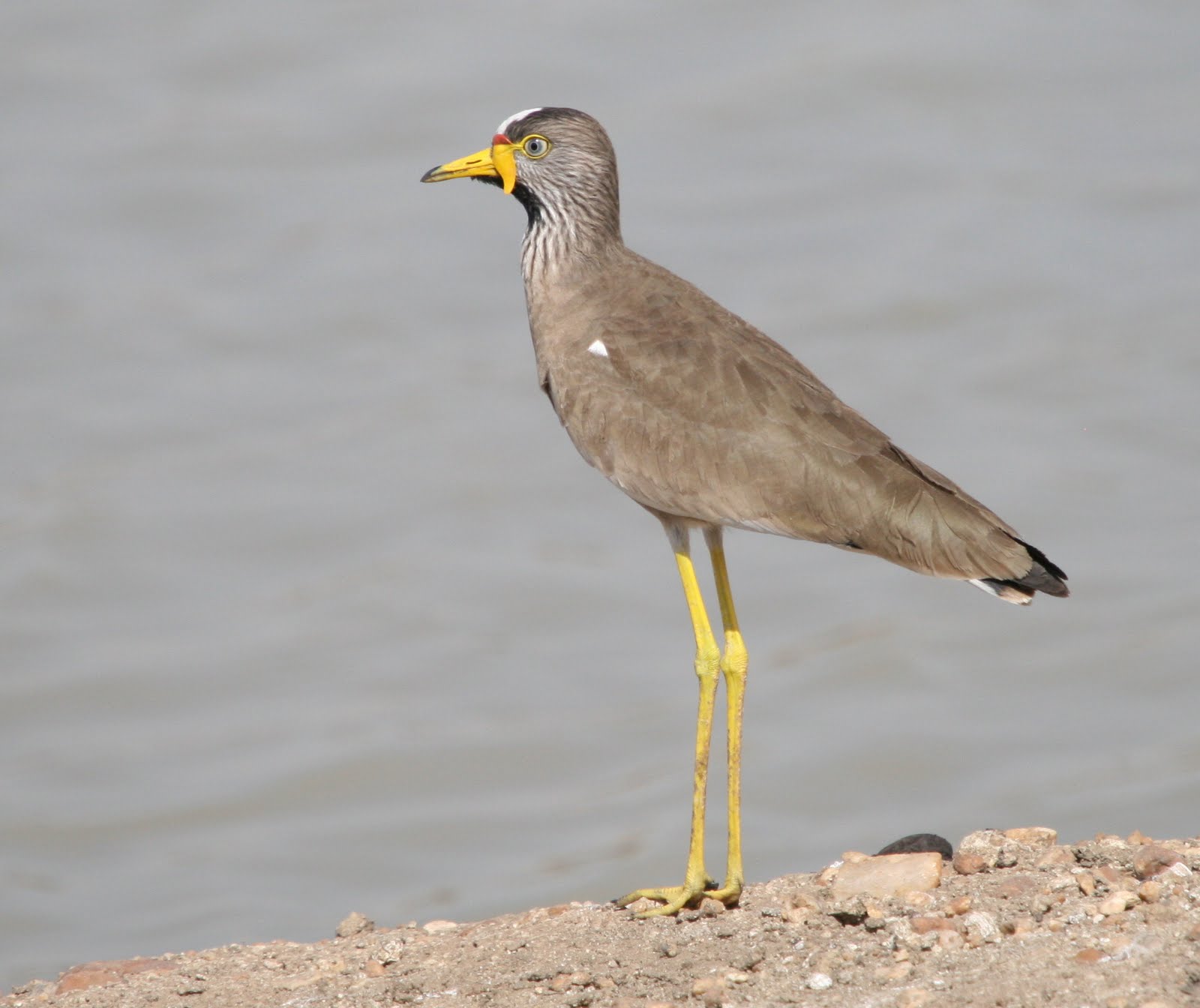
On one of the flooded pits were a flock of African Wattled Lapwings Vanellus senegallus, Sacred Ibis Threskiornis aethiopicus and African Open-billed Storks Anastomus lamelligerus.
Sacred Ibis with African Open-billed Storks
African Wattled LapwingI'll finish this post with a few raptors. First a pair of Wahlberg's Eagles Aquila wahlbergi, including a stunning pale phase bird.
Pale phase Wahlberg's Eagle
The other bird of the pair
Next some blurry vultures (sorry, they were miles up)....
White-headed Vulture Trigonoceps occipitalis
Rueppell's Griffon Vulture Gyps rueppellii
Black-chested Snake-Eagle
Tuesday, 1 February 2011
Wintering birds at Fenti
Saturday, 29 January 2011
Juba in the dry season
Presumed immature parasiticus or aegyptius subspecies of Yellow-billed Kite
There are still several tens of Hooded Vultures Necrosyrtes monachus present, often near the abattoir. This area also hosts a population of at least 60 Piapiacs Ptilostomus afer, a curious long-tailed crow that I was delighted to find. In Kenya, where I used to live, the species is very localised along the Ugandan border. In Juba, Piapiacs are not associated with cattle (and obviously not game animals), contra the statement in Stevenson and Fanshawe’s Birds of East Africa, which is my only reference book at present.
Piapiacs
Other typical Juba birds are African Mourning Doves Streptopelia decipiens and Grey-backed Fiscals Lanius excubitoroides.
There are a few small wetland areas immediately around the town, and of course the White Nile flows along the eastern edge. Sacred Ibis Threskiornis aethiopicus have arrived, with a total of 92 seen flying to roost by the White Nile in 30 minutes earlier this week. A small marsh 3kms out of Juba held a variety of herons today, as well as two Yellow-billed Storks Mycteria ibis, which hunted in the shallow water by shading the surface with one wing extended.
Sedges along the edge were full of non-breeding plumage Bishops Euplectes sp. There were also a pair of Blue-headed Coucals Centropus monachus, Winding Cisticolas Cisticola galactotes, Zitting Cisticolas Cisticola juncidis uropygialis and Yellow Wagtails Motacilla flava (subspecies not determined).

Winding Cisticola
Woodchat Shrike
Isabelline Shrike
Residents or local migrants include Foxy Cisticola Cisticola troglodytes, Brown Babbler Turdoides plebejus, Black-headed Gonolek Laniarius erythrogaster, White-browed Sparrow-Weaver Plocepasser mahali, Speckle-fronted Weaver Sporopipes frontalis, Little Weaver Ploceus luteolus and Black-rumped Waxbill Estrilda troglodytes. Perched at intervals on tree tops are Dark Chanting-Goshawks Melierax metabatesi and Grasshopper Buzzards Butastur rufipennis.
That's a taster...more to follow.
Saturday, 22 January 2011
What is the status of glossy starlings in Khartoum?
However, I thought the Greater Blue-eared Starling was supposed to be a resident here. They also declined in numbers and I saw my last one on October 29th (at least that is the last record in my notebooks and I may have seen them casually after this date). I saw one today beside the Blue Nile, while I was not birding. I wonder if a few hang around, but most leave. I will try and monitor them more closely and try and find a pattern. If anyone has any observations to add, they would be welcome.
Friday, 21 January 2011
Blue Nile beaches
Many of the typical waders are more for the serious birder, being similar in shape, brown and quite difficult to identify without experience. In the photo below the yellow leg colour separates Temminck's Stint from the similar, but black-legged, Little Stint. Marsh Sandpiper can be easily confused with the larger Greenshank, but the photos below show the fine delicate bill of the Marsh Sandpiper compared with the thick, slightly upturned bill of the Common Greenshank. Other species included Curlew Sandpiper, Common Sandpiper, and Ruff.
There were several plovers present including Common Ringed Plover, Little Ringed Plover, Kittlitz's Plover and Spur-winged Plover (or lapwing).
There were also several species of tern flying up and down the river. Most common were Whiskered Tern and Gull-billed Tern, but White-winged Black and Caspian Terns were also around. I was surprised to see that some of the Whiskered terns are already showing their breeding plumage. Another surprise was a Gull-billed Tern that chased a much larger Caspian Tern up and down the river for several minutes to try and take the fish it was carrying. This is common amongst terns, but it is usually the larger species that takes food from the smaller one.


Grasshopper Buzzard