Saturday, 30 November 2013

Red-knobbed Coots at Khartoum sewage treatment plant

Today I made my first visit to the Khartoum sewage treatment plant which lies to the south of the city. I went there with Marwa, and on the way there she discussed how she felt sure she had seen Red-knobbed Coot on a previous visit, but that people had told her she must be mistaken. As soon as we arrived we looked out across the pools and saw several coots. It didn't take long before we had good views and it was obvious that they were all Red-knobbed (or Crested) Coots; a species not previously recorded from Sudan. There were about 25 in total, on two of the 6 big pools.

Red-knobbed Coot, Khartoum sewage treatment plant 30th November 2013

There were also quite a few ducks present. One looked like it might be a Red-billed Duck, but they were a bit distant and we needed to set up some nets for bird ringing, so we decided to check them properly later. On our return we went to check one of the pools and the ducks were no longer there. At the second pool we quickly flushed a number of Red-knobbed Coots and Southern Pochards from the bank close beside us. There were 6 Southern Pochards and, like the bird seen in Bahri two weeks ago, they were all males. Unfortunately, there was no sign of a Red-billed Duck, but there were 3 Tufted Ducks, which I believe are my first sightings in Sudan. I took a few photos and when checking them at home, I saw a bird in the background that may also be a new record for the country - a Cape Teal! Unfortunately the photos are not good as the bird is only in the background. I will need to get it verified, plus I will try and return soon to check on it. The two main pools also had some Hottentot Teals - with 3 on one pool and 2 on the other.
(Later Edit: Having checked with people on Birdforum it is evident that this is not a Cape Teal. The main feature suggesting this species was the apparent red bill, but it seems that this is probably a trick of the light. It is probably a Gargany or Common Teal).

Bird we originally thought might be a Cape Teal, Khartoum sewage treatment plant 30th November 2013
(Almost certainly a Gargany, or possibly a Common Teal) 

Southern Pochards, Khartoum sewage treatment plant 30th November 2013 

Tufted Duck with Southern Pochard, Khartoum sewage treatment plant 30th November 2013

Hottentot Teal, Khartoum sewage treatment plant 30th November 2013

Other good birds present included African Swamphen, hundreds of Moorhens (including many juveniles), lots of Little Grebes, Lanner Falcon, and Marsh Harrier. We had little luck with the nets, but this was not much of a concern given the good birds we had seen. In the published literature Sudan has no records of Red-knobbed Coot, nor Cape Teal, there is one record of Hottentot teal and one record of African Swamphen, plus Southern Pochard and Red-billed Ducks are very rare this far north. Admittedly the Cape Teal awaits confirmation and I need to return and check on the Red-billed Duck, but this will be a great haul of good birds regardless of whether or not they are confirmed. I can see us making regular trips here and Marwa and I have already discussed preparing our combined sightings for publication. Birders further north in Egypt may want to start checking some sewage sites in the south of the country to see if these birds go any further north. We already know that the Swamphen does.

Friday, 15 November 2013

Bahri Sewage Pools

Today I made a visit to the sewage pools just outside Bahri with Marwa Taha, who is studying birds at sewage works in the region; her main interest being the effects of heavy metals on birds. I once made a brief visit here with Mark Mallalieu back in 2010, but there is no public access and we were only able to view from the roadside verge. Marwa has permission to enter to make her studies, giving us access to what looks like being an excellent site for waterbirds, with several large open, nutrient-rich pools surrounded by reeds. Bird of the day was definitely a Southern Pochard, which has only rarely, if ever, been seen this far north. It stayed around the opposite side of the pool giving distant views, but the blue bill was distinctive at quite long range.

Southern Pochard, Bahri Sewage Pools15th November 2013

There were many other ducks present, which mainly appeared to be Garganys, Shovelers, and  White-faced Whistling Ducks, plus 5 Hottentot Teal and a few Northern Pintail. There were also big numbers of Little Grebes, plus plenty of Moorhens and a couple of Common Coots (only my second sighting in Sudan).  There were also a couple of Marsh Harriers and quite a few Sacred Ibises, which Marwa observed breeding here earlier in the year.

One of the sewage pools near Bahri, 15th November 2013

As well as viewing the local birds, we put up nets to see what we could catch - my interest, as always, being the local weavers. Unfortunately, the birds here are no longer in breeding plumage and I cannot be certain which species I was catching, though they are most likely to be Northern Masked Weavers. Hopefully I will be able to sort this out later in the year when I see breeding birds, or if I manage to find a feature for separating non-breeding Northern Masked and Cinnamon Weavers.

Juvenile Weaver (probably Northern Masked), Bahri Sewage Pools15th November 2013

There were lots of Sedge Warblers in the reeds, plus a few Reed Warblers and various other species, some of which went into the nets.

Sedge Warbler, Bahri Sewage Pools15th November 2013

Eurasian Reed Warbler, Bahri Sewage Pools15th November 2013

Common Chiffchaff, Bahri Sewage Pools15th November 2013

Immature Yellow Wagtail, Bahri Sewage Pools15th November 2013

Female House Sparrow, Bahri Sewage Pools15th November 2013

Little Stint, Bahri Sewage Pools15th November 2013

Common Sandpiper, Bahri Sewage Pools15th November 2013

This site has a lot of potential and I look forward to returning again soon. Marwa has a great location here for her research and I look forward to seeing what she turns up in her future visits.

Monday, 4 November 2013

More netting in Sennar

I was back in Sennar at the weekend to continue my study of Cinnamon Weavers at the colony there. I had limited luck with the weavers and most seemed to have left the nest and few were sticking around to be caught. However, there were still some other interesting birds around. There were plenty of shrikes, including at least two Woodchat, two Isabelline and one Southern Grey, but even though they were hanging around near the nets, none flew in. Conditions for mist-netting were not good as there was a lot of wind and I think the nets were too visible for birds with such keen eyesight. There were also lots of groups of Hoopoes around, but again no luck with the nets.

Woodchat Shrike, Sennar November 2013

Although there were much fewer birds caught than last time, there were still some interesting species. The bird below was in heavy moult and was completely growing back its tail. It also had a gape flange, suggesting it was a young juvenile bird. This made the identification tricky, as I was expecting it to be a resident species. Only by putting the photos on Birdforum (www.birdforum.net) was I able to get it identified as a Menetries Warbler. I have generally found that there are experts on Birdforum from just about every branch of ornithology, with knowledge from all parts of the globe, and I am usually able to get any tricky species identified pretty quickly there.

Menetries Warbler, Sennar November 2013

A few other good birds are shown below.

Black Scrub Robin, Sennar November 2013

Common Redstart, Sennar November 2013

Female Red-billed Firefinch, Sennar November 2013

Lesser Whitethroat, Sennar November 2013

Northern Wheatear, Sennar November 2013

Red-cheeked Cordon-bleu, Sennar November 2013

Village Weaver, Sennar November 2013

Friday, 25 October 2013

More netting at Soba Sewage Pools

I returned to Soba Sewage Pools today to catch some more Northern Masked Weavers. Once again I had a lot of success, catching 21 weavers using only a single net. These were all new birds, with no re-traps from last week. This suggests there are a lots in the area. Nearly all were in heavy moult. I also caught a few other species of interest.

Eastern Olivaceous Warbler, Soba Sewage Pools 25th October 2013

Common Sandpiper, Soba Sewage Pools 25th October 2013

Northern Red Bishop, Soba Sewage Pools 25th October 2013

Willow Warbler, Soba Sewage Pools 25th October 2013

Greater Blue-eared Starling, Soba Sewage Pools 25th October 2013

Although I was not carrying binoculars or carrying a camera while netting, I was also able to see an African Purple Swamphen, plenty of Common Moorhens, and a Hottentot Teal. 

Saturday, 19 October 2013

Netting at Soba Sewage Pools

I decided to try some netting today at the Soba Sewage Pools in the hope of catching some Northern Masked Weavers. There were a lot of juvenile birds around and many of the adults were in moult, suggesting it is the end of the breeding season for them. I managed to catch 17 weavers in total. They were easy to catch and I could have caught many more, but I am taking lots of measurements and I had to keep closing the two nets I was using to concentrate on collecting this biometric data.

Moulting male Northern Masked Weaver, Soba Sewage Ponds 19th October 2013

Juvenile Northern Masked Weaver, Soba Sewage Ponds 19th October 2013

As expected, there were plenty of other good birds caught in the net, though I was less inundated than I was earlier in the week at Sennar and on this occasion more than half of the birds caught were weavers. There was one of each of the birds caught below, plus a Namaqua Dove, a couple of House Sparrows and a couple of Northern Red Bishops.

Spur-winged Lapwing, Soba Sewage Ponds 19th October 2013

African Mourning Dove, Soba Sewage Ponds 19th October 2013

Wood Sandpiper, Soba Sewage Ponds 19th October 2013

Sedge Warbler, Soba Sewage Ponds 19th October 2013

Thursday, 17 October 2013

Sennar Birding and Netting

I have just returned from 4 nights in Sennar, which lies on the Blue Nile about 250km South of Khartoum. My main interest was a study I am conducting there on Cinnamon Weavers, but in this posting I will refer more to the other birds seen or captured during netting activities.

It is usually quite easy to drive on Fridays as the traffic is generally quite light, but with Eid approaching the roads were unusually busy with people heading home to see families. On the way down I saw my first Bataleur in Sudan, just north of Wad Medani. As always, there were lots of Pied crows on this section of the road, though it was a surprise to see no others further south. Similarly, I saw several Ruppell's Starlings around Wad Medani, but none further South. Greater and Lesser Blue-eared Starlings were also conspicuous in their absence throughout the trip, suggesting they may have left early this year. Other birds seen only on the drive there and back were African Grey Hornbill, Yellow-billed Stork and Marabou Stork (just south of Khartoum).

Once in Sennar I went straight to work in finding a study site for Cinnamon Weavers and soon located a place just north of the city. From here on my main interest was the weavers, but I also had the chance to see some good birds in the area, which was mainly crop farmland a couple of km from the Blue Nile. There were a number of species here that are much less commonly seen further north. A few are pictured below:

Abyssinian Roller, Sennar October 2013

Black-headed Lapwing, Sennar October 2013

Black-shouldered Kite, Sennar October 2013

Red-backed Shrike, Sennar October 2013

Speckled Mousebird, Sennar October 2013

Yellow-breasted Barbet, Sennar October 2013

It was exciting to finally get some nets up near a Cinnamon Weaver colony. There seemed to be birds everywhere and I knew that I would catch some good stuff. Unfortunately, although I only had 4 nets, the birds came so quickly that I struggled to handle them all on my own and I often had to shut the nets to slow things down. Net-fulls of House Sparrows and Northern Red Bishops kept me occupied, plus quite good numbers of Cinnamon Weavers, each one of which took a long time to process as I was taking lots biometric data. In most cases I only had time to take a quick snapshot of other species before immediately releasing them. It was still great fun to handle these amazing birds:

African silverbill, Sennar October 2013

Yellow Wagtail (beema), Sennar October 2013

Blue-cheeked Bee-eater, Sennar October 2013

Common Whitethroat, Sennar October 2013

Female Sudan Golden Sparrow, Sennar October 2013

Male Sudan Golden Sparrow, Sennar October 2013

Laughing Dove, Sennar October 2013

Little Weaver, Sennar October 2013

Northern Red Bishop, Sennar October 2013

Namaqua Dove, Sennar October 2013

Nile Valley Sunbird, Sennar October 2013

Red-billed Firefinch, Sennar October 2013

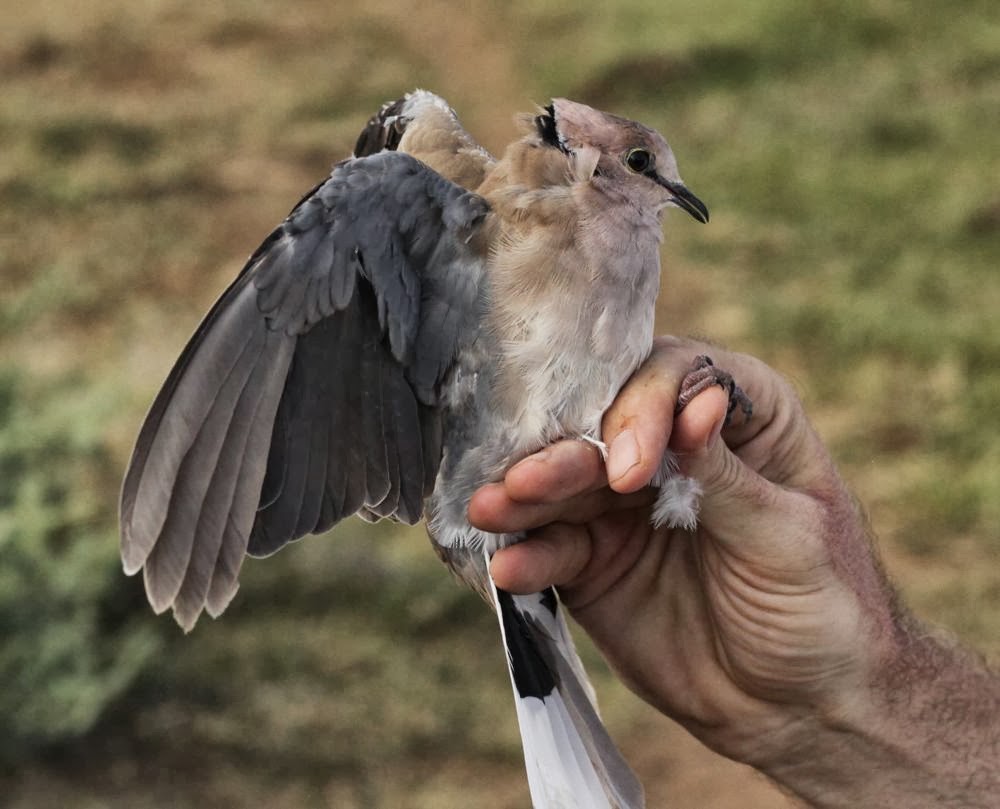
Vinaceous Dove, Winding Cisticola and Yellow-crowned Bishop were all my first sightings in Sudan and with all three of them the first I knew of them being there was when I pulled them from the nets. Other first sightings for Sudan included Grasshopper Buzzard and Woodchat Shrike, while Grey-headed Kingfisher was only my second sighting.

Vinaceous Dove, Sennar October 2013

Winding Cisticola, Sennar October 2013

Yellow-crowned Bishop, Sennar October 2013

And finally, the birds I had been waiting so long to capture, measure and ring - the Cinnamon Weaver:

Male Cinnamon Weaver, Sennar October 2013

Female Cinnamon Weaver, Sennar October 2013

I hope to publish some more on my Cinnamon Weaver study soon, plus I hope to get back for another visit in the not-too-distant future.