Friday, 10 February 2012

A brief visit to the Sunt Forest

Last Friday (February 3rd) I made a brief visit to the Sunt Forest. I was most interested in visiting the forest to look for land birds. There were big numbers of Lesser Whitethroats and lots of Eastern Olivaceous Warblers, but not much else of interest in the forest. Much of the pools had dried up, but there was still a similar selection of shorebirds to previous visits, though in smaller numbers. The best bird of the day was an immature Great Spotted Cuckoo in the more open area at the edge of the forest. This was my first sighting of this species in Sudan.

Great Spotted Cuckoo, Sunt Forest 3rd February 2012

I also spent a bit of time trying to photograph a wheatear that I thought might be a Cyprus Wheatear, but could also have been a Pied wheatear. The first thing to determine was whether it was a male or female. If female it would definitely not be a Pied Wheatear, which has a much plainer female plumage. The dark crown suggested a female, but I was unsure whether a first-year male Pied might still have such a plumage. I put the photos onto Birdforum (Click here) and soon had a reply from Brian Small (one of the top birders in Africa and Illustrator of Birds of the Horn of Africa, the main bird book to use in Sudan) which indicated why it was not a Cyprus Wheatear, but in fact a first-year Pied Wheatear. Apparently the crown was not dark enough and the underparts not burnt enough to be a Cyprus. He also discussed how the 3rd primary could be seen to be the longest in one photo, whereas in Cyprus the longest primary should be number 4. Its nice to have such expertise available to help out with identification. Birdforum really is a great place to go for such things.

Pied Wheatear, Sunt Forest 3rd February 2012

Pied Wheatear, Sunt Forest 3rd February 2012 

The wintering range of the Cyprus Warbler is still little known, but it seems that Sudan may be the main area. I hope to keep tabs on records of this species, but it evident that I still need to get my head around the identification. Another interesting sighting was a Speckled Pigeon that flew overhead - my second sighting at this location.

Friday, 3 February 2012

Visit to KICS stables on the Blue Nile

The school where I work (KICS) has a stables on the Blue Nile just south of Khartoum. It is a lovely location with many good birds and I have seen over 80 species on my various visits. I made a couple of short visits last week to see what was around. One of these visits was with the riding instructor David Hancock, who is also a birdwatcher. The riding club is approved by the UK Pony Club, which encourages the students to study for badges in various activities related to riding, but also other activities, including birdwatching. David and I discussed how we could introduce the birdwatching badge and get some of the students to learn some of the birds in the area. With quality species like Egyptian Plover available on most rides along the beach, there will be plenty for them to look at.

Egyptian Plover, KICS Stables Blue Nile January 2012

Common Stonechat, KICS Stables Blue Nile January 2012

Northern Wheatear, KICS Stables Blue Nile January 2012


A couple of trip reports by Yousif

I was out of the country for about a month while Yousif Attia and his fiancé Patti were in Sudan, so unfortunately I was unable to join them on any more trips. However, Yousif has sent me a report of a trip they made to Tuti Island and another to Sabaloka, plus a number of photos. I am grateful to him for letting me post them below. I was particularly interested to hear about the Cinnamon Weavers, which extends their known range slightly north of that shown by Nikolaus. I hope to get up there soon to see if they are still around. Yousif also mentioned seeing a Cream-coloured Courser on a brief visit to near the Sunt Forest. This is a species I have still never seen despite lots of searching in several countries.


December 22, 2011

Patty and I took a morning walk to explore Tuti Island a little more.
We saw much of the same as the previous trip but there were a few more birds around.  Cut-throats were the most abundant species today with small groups all over the island and I estimated no less than 250.  Flocks of Pin-tailed Whydahs had a couple males in breeding and transitional plumage.  A Masked Shrike was at the extreme northern end of the island as well as a large group of Little Bee-eaters and a single Wryneck.  Raptors were on the move and I noted a European Honey-Buzzard among the numerous kites. A pair of Egyptian Geese flew by and there was a large feeding flock of White-winged Terns and 2 Caspians. The Black-headed Lapwings continued to show well and a nice male Common Redstart was nice to see.  We were excited to see a couple Red-cheeked Cordon-bleus and a pair of Rose-ringed Parakeets flew overhead.  Black-billed Wood-pigeons showed well which were missed on our initial visit here.

Village Indigobird

Black Scrub-Robin

Black-headed Lapwing

Blue-naped Mousebird

Cut-throat Finch

Egyptian Plover

Namaqua Dove

Plain Martin

White-browed Coucal

December 23, 2011

A group of relatives and friends took Patty and I on a trip to the 6th Cataract or Sabaloka "waterfalls".  Bird diversity was not particularly high but the bushes were active with palearctic migrants, primarily Lesser Whitethroats.  Three Abdim's Storks circled over the hills.  A number of House Buntings (Striolated), Blackstarts and a Blue Rock-Thrush were of note as well as a single Rufous-tailed Shrike (IsabelineShrike). It is interesting to note that many of the local weaver males were in full alternate plumage, in contrast to the birds at Tuti the past few days, which have virtually all been in confusing basic plumage.   We hired a boat which took us up the rapids and on a sand flat area of the island across Sabaloka.  There were a number of shorebirds including Black-winged Stilt, Common Greenshank, Common Sandpiper, Curlew Sandpiper Little Stint, Common Ringed Plover, Kentish Plover and Egyptian Plover.  Our guide then drove the boat directly across the sand flat to a narrow lush strip of trees along the bank of the Nile after hearing we were seeking birds.  Both Little and Green bee-eaters were found as well as a Striated Heron and a pair of Pied Kingfishers. The true prize for the day however was while drifting by a confirmed but brief look at a male Cinnamon Weaver singing in what looked like a loose colony.  I really did not expect to see this as I had ruled them out after seeing how all the weavers were in basic plumage.  Also present was a male Little Weaver making it a 4 weaver species day.  I later saw a female weaver which had much browner tone and I assume it may have been a Cinnamon Weaver as well.  All in all it was a productive day and we had a delightful picnic by the water to round it off.

Yousif Attia - January 2012

Tuesday, 20 December 2011

An evening visit to Tuti with Yousif and Patti

Today I made a brief evening visit to Tuti with Yousif (a birder visiting from Canada) and his fiancé Patti. The main aim of the trip was to show them where to go on Tuti Island and how to find the Sunt Forest, as I will be out of the country for most of their time here. Time was short as we didn't get to Tuti until nearly 5pm, but we still managed to see a few good birds. Last visit I had seen some Black-headed lapwings and we twice saw some today, though it wasn't clear if they were two different groups. There were lots of Chiffchaffs around and some large groups of weavers that were difficult to identify as none were in breeding plumage. We managed to find a few new species for Yousif, such as a group of Crimson-rumped Waxbills, plus a Gabar Goshawk showed well just as the light was fading.


Crimson-rumped Waxbill, Tuti Island 20th December 2011

Gabar Goshawk, Tuti Island 20th December 2011

By the time we reached the Sunt Forest it was too late to see any birds, but hopefully Yousif and Patti will be able to return and see plenty at a later date.

Saturday, 17 December 2011

Tuti Island and the Sunt Forest with Terry

Terry and I visited Tuti Island yesterday, followed by a brief visit to the Sunt Forest. A group of three Black-headed Lapwings was a nice find and the first that Terry has seen here.

Black-headed Lapwing, Tuti 16th December 2011

As we arrived on Tuti we saw an unidentified Accipiter that seemed to be mobbing a Common Kestrel; surprisingly, this was the first I've seen on the island. We saw a few other Accipiters elsewhere on the island, including a couple chasing each other. One, at least, was an adult Eurasian Sparrowhawk. A Lanner Falcon was also hunting near the northern end of the island. There was a small tree near the northern end of the island containing a flock of about 10 Yellow Wagtails, plus there were a few others feeding in the field nearby. Neither of us recall seeing a flock of Yellow Wagtails in a tree like this, and we wondered if perhaps the number of small raptors around today might have been making them wary. A few Sudan Golden Sparrows were in the tree with them

Yellow Wagtails in tree, Tuti 16th December 2011

Sudan Golden Sparrow, Tuti 16th December 2011

There was little of note at the Sunt Forest that had not been present last visit, though we only stopped briefly and spent little time in the actual forest. The pools that had been good for waterbirds on the last few visits have now nearly dried up, so waterbirds are mainly located on the banks of the White Nile.There were no flamingoes present this time. At least one of the Whiskered Terns was already in summer plumage.


Friday, 2 December 2011

The Sunt Forest

I visited the Sunt Forest again today with Stephen and Terry and there were some interesting new sightings. One pleasant surprise was a flock of 125 Greater Flamingoes. The map in Nikolaus shows that it has been recorded here, but shows few other inland locations marked so I had assumed that it would be quite rare away from the Red Sea. There were a number of spoonbills with them that were too far to identify, but there was one Eurasian and one African Spoonbill closer to confirm that both were present. Nikolaus describes the Eurasian Coot as uncommon and shows scattered locations throughout Sudan, including Khartoum. Somehow the bird seemed different to the ones I have seen elsewhere, with much less white on the forehead, but it was clearly not any other species (the black point in front of the eye distinguishing it from Red-knobbed Coot).

Greater Flamingoes, Sunt Forest 2nd December 2011

African Spoonbill, Sunt Forest 2nd December 2011

Eurasian Coot, Sunt Forest 2nd December 2011

There were not large numbers of waders present, but a reasonable selection of different species.  Common Redshank and Terek Sandpiper are both supposed to be common on the coast but rare to uncommon inland. Spotted Redshank are also supposedly uncommon, yet all three were present today.

Common Redshank, Sunt Forest 2nd December 2011

Terek Sandpiper, Sunt Forest 2nd December 2011

Black-tailed Godwit, Sunt Forest 2nd December 2011

Curlew Sandpiper, Sunt Forest 2nd December 2011

These Egyptian Geese were my first sightings in Sudan. There were also a couple of Eurasian Wigeons which were also my first sightings here. Otherwise, there were just a few Northern Shovelers present.

Egyptian Geese, Sunt Forest 2nd December 2011

We spent a bit of time in the forest, but there were few birds present other than Lesser Whitethroats, Eastern Olivaceous Warblers, Common Bulbuls, White-headed Babblers and a single Masked Shrike. Most interesting was a large group of Grivet Monkeys.

Grivet Monkey, Sunt Forest 2nd December 2011

Friday, 18 November 2011

Jebel Aulia with Stephen

I visited Jebel Aulia this morning with Stephen Blight. The water levels were quite high, but there were still some waders along the sandy shores. There were several Kentish Plovers, which were my first in Sudan. There were also a number of other species, such as: Ringed Plover, Kittlitz's Plover, Spur-winged lapwing, Ruff, Little Stint, Greenshank, Common Sandpiper and Ruddy Turnstone. As the water levels fall there may be more exposed mud, and this should attract more birds and a wider range of species.

Kentish Plover, Jebel Aulia 18th November 2011

Other water birds included several heron species, some Eurasian Spoonbills flew over, a group of ducks flew across the lake, there were several Lesser Black-backed Gulls and lots of terns. These were especially common just below the dam, with lots of Whiskered and White-winged Black Terns, plus a few Caspian and Gull-billed terns.

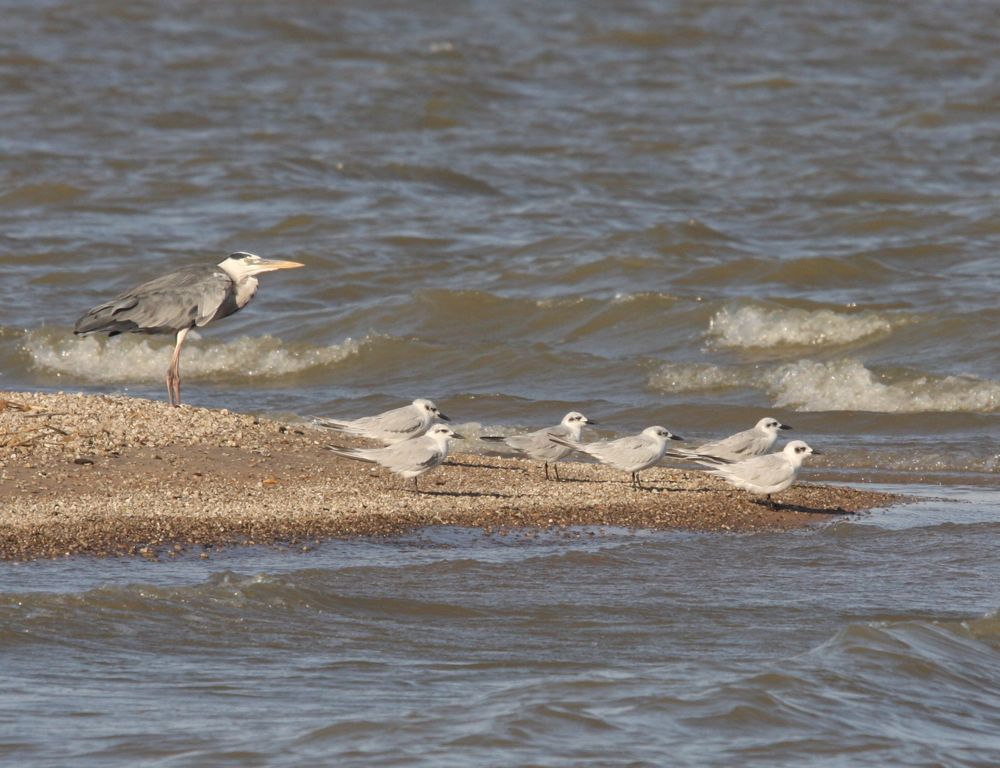
Gull-billed Terns with Grey Heron, Jebel Aulia 18th November 2011

Pintails, Shovelors and Gargany, Jebel Aulia 18th November 2011

There were a few wintering landbirds present including, surprisingly, my first Chiffchaffs of the year.  There were lots of Lesser Whitethroats and Desert Wheatears. More interesting sightings included Wryneck, Barred Warbler and Isabelline Shrike. I have now seen Isabelline Shrikes on many occasions in Sudan, including at Jebel Aulia. I was surprised to hear that they are quite a rare bird in Egypt, making me wonder how they get here. This presumably means they are not moving down the Nile, but possibly coming across from the direction of the Red Sea.

Barred Warbler, Jebel Aulia 18th November 2011

Wryneck, Jebel Aulia 18th November 2011

Isabelline Shrike, Jebel Aulia 18th November 2011